Tailor made
Ever wondered how other succeed in their digital signage projects? Multibrackets is often an important component of digital signage projects worldwide creating the right solutions for your projects.
Our Custom design support can be used for multiple purposes:
Tailored products:
High quality designed Products often aimed to serve a single customers need, often with a specific screen in mind.
Store concepts:
Products aligned with your corporate store concept.
Marketing campaign products:
Products custom made and painted in corporate color.
Digital Signage & other Metal Tech Solutions
We help you enhance your customer experience and create business value.
Get your project started, and send us your request here: tailormade@multibrackets.com
Let’s start your next digital signage project today!
Ever wondered how other succeed in their digital signage projects? Multibrackets is often an important component of digital signage projects worldwide creating the right solutions for your projects.
Multibrackets is in close partnership with Samsung, Philips, LG and other prominent display manufacturers, creating solutions optimized for each display and situation. By utilizing Multibrackets in your project we will take you behind the scenes in our Design Studio, create solutions for your projects or utilize our standard solutions best aimed to solve your tasks.
As one of Scandinavia´s biggest designer & manufacturer of digital signage solutions we currently have well over 2000 SKU´s and create tailormade solutions. We are very much looking forward to your request here:
tailormade@multibrackets.com
LED Project Essentials – What You Need to Know
LED Screen Parameters – Explained in Plain Language
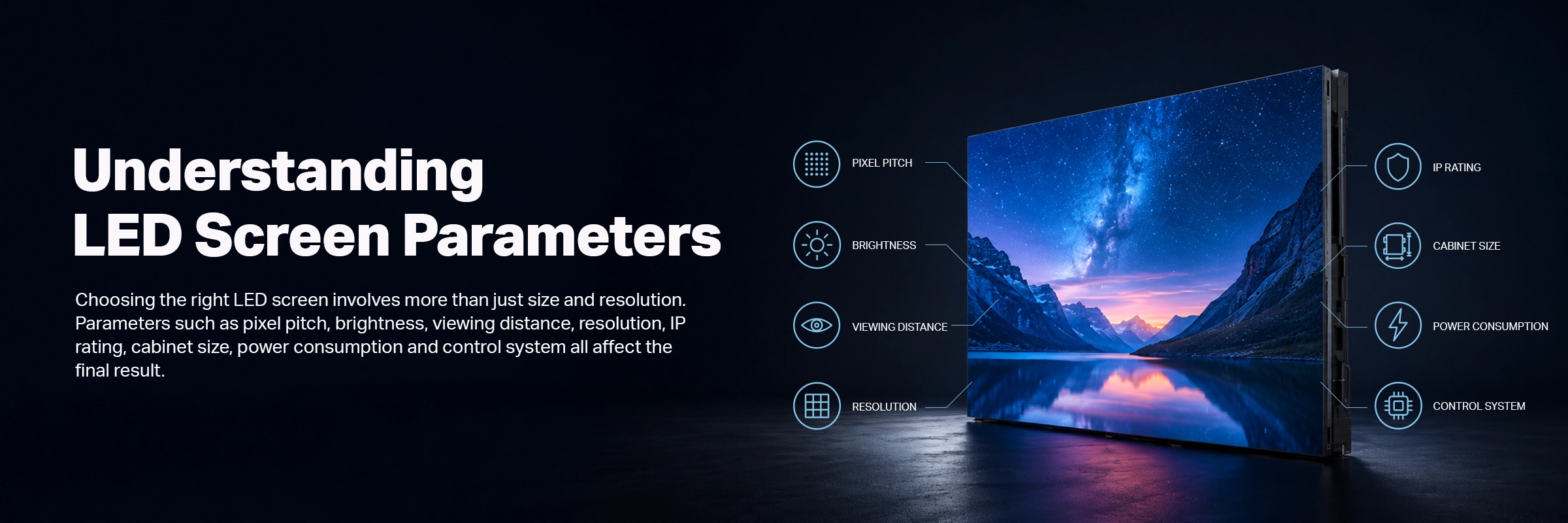
Choosing the right LED screen involves more than just size and resolution. Parameters such as pixel pitch, brightness, viewing distance, resolution, IP rating, cabinet size, power consumption and control system all affect the final result.
This guide explains the most important LED screen parameters in plain language — what they mean, why they matter, and what information you need to provide to get the installation right.
And once you have selected the right LED solution, Multibrackets has a suitable professional mounting solution to complete the installation — whether the screen is mounted on a wall, suspended from the ceiling, supported from the floor or installed using wire suspension.
01 / PITCH
Pixel pitch
Pixel pitch is the distance between the centres of neighbouring LEDs, measured in millimetres — P2.5 means 2.5 mm.
The smaller the number, the finer the image will appear at close viewing distances, but the higher the price per m². Indoor applications are typically P1.5–P3, shop windows around P3–P4, and facades and billboards P6–P10.
There is no reason to pay for a finer pitch than viewers can actually resolve from their typical viewing distance.
INCLUDE IN YOUR INQUIRY
The distance from the screen to where viewers will most often be standing, in metres.
02 / NITS
Brightness
Brightness is measured in nits (cd/m²).
An indoor screen is typically fine with 600–1,000 nits. A shop-window screen exposed to daylight may require 2,500–3,500 nits, while an outdoor screen in direct sunlight may require 4,500–6,500+ nits.
Good LED screens can automatically adjust brightness according to ambient light. This saves energy and prevents excessive brightness and glare when the environment becomes darker.
INCLUDE IN YOUR INQUIRY
Indoor / shop window / outdoor, and the screen's orientation in relation to the sun.
03 / DIST
Resolution & viewing distance
As a rule of thumb, the minimum comfortable viewing distance in metres is approximately equal to the pixel pitch in millimetres.
For example, P4 generally looks good from around 4 metres and beyond.
Resolution is determined by the physical screen dimensions and pixel pitch. A 4 × 2 m screen at P4 has approximately 1,000 × 500 pixels.
This determines how much detail your content can display.
INCLUDE IN YOUR INQUIRY
Screen width × height and the shortest typical viewing distance.
04 / IP
IP rating & durability
The IP rating indicates how well the LED screen is protected against dust and water.
IP20 is generally sufficient for indoor applications. Outdoor installations typically require IP65 at the front, providing protection against rain and dust, and at least IP54 at the rear, depending on the installation.
Also consider operating temperature, UV exposure, humidity and, for facades and exposed locations, wind load and structural requirements.
INCLUDE IN YOUR INQUIRY
Indoor / outdoor installation and any specific environmental conditions, such as dust, moisture, direct sunlight, coastal environments or extreme temperatures.
05 / SIZE
Size & format
LED screens are assembled from individual cabinets, typically 500 × 500 mm or 500 × 1,000 mm, depending on the LED system.
The final screen size can therefore be highly flexible and does not have to follow a standard 16:9 format. A digital notice board can be portrait, while a screen above an entrance could be a wide 8:1 format.
For larger installations, the available wall, ceiling or floor structure and its load capacity must also be considered.
INCLUDE IN YOUR INQUIRY
Required width × height, even approximately, and where the screen will be installed.
06 / POWER
Power & operation
Power consumption varies depending on the LED technology, brightness, content and operating conditions.
As a general indication, expect approximately 150–350 W/m² average consumption, with higher peak consumption possible.
For example, an 8 m² outdoor screen could consume around 2 kW on average, depending on the specific LED solution.
LED systems can have a rated lifetime of 80,000–100,000 hours, depending on the manufacturer and operating conditions.
INCLUDE IN YOUR INQUIRY
Daily operating hours and available electrical power at the installation location.
07 / CMS
Control system & content
LED screens can be operated through a connected computer for live content, or through an integrated media player with scheduling capabilities.
A modern CMS allows you to manage content remotely, schedule campaigns, monitor screen status and manage multiple screens from one location.
Depending on the application, the system can also be integrated securely into an existing network infrastructure.
INCLUDE IN YOUR INQUIRY
How the screen will be used, how content will be managed and whether remote control or scheduling is required.
INSTALLATION PARAMETERS
Once the LED screen itself has been specified, the next step is determining how and where it will be mounted.
The mounting method has a direct impact on the required structure, dimensions, access, cable routing and installation time.
08 / MOUNT
Mounting method – Wall, Floor, Ceiling or Wire
An LED screen can typically be installed using several different mounting principles:
- Wall-mounted – fixed directly to a suitable wall or supporting structure.
- Floor-standing – supported from the floor using a dedicated frame or structure.
- Ceiling-suspended – suspended from the ceiling or an overhead supporting structure.
- Wire-suspended – suspended using wire or cable systems where appropriate.
The mounting solution must be designed around the total weight, centre of gravity, cabinet configuration and the supporting structure.
INCLUDE IN YOUR INQUIRY
Preferred mounting method: wall / floor / ceiling / wire — and what type of structure is available.
09 / HEIGHT
Installation height & position
The height of the LED screen is important both for viewing comfort and installation design.
For a floor-standing installation, specify the distance from the floor to the bottom edge of the first LED panel/cabinet.
For a ceiling-mounted or suspended installation, specify the distance from the ceiling or suspension point to the top edge of the LED screen.
Also consider whether people need to walk underneath the screen, whether there are doors or other obstacles nearby, and how the screen will be accessed for installation and service.
INCLUDE IN YOUR INQUIRY
Floor-mounted: floor → bottom of first panel.
Ceiling-mounted: ceiling/suspension point → top of screen.
Wall-mounted: floor → bottom of screen and any required clearance.
10 / STRUCTURE
Load, access & service
The LED screen is only one part of the installation. The supporting structure must be able to safely carry the total weight of the screen, mounting system and any additional equipment.
For larger or outdoor installations, wind load and the condition of the existing structure may also need to be assessed.
Think about service access from the beginning. Depending on the LED system, panels may require front or rear access for maintenance and replacement.
Cable routing, power supplies, ventilation and access for installation should also be considered before the mounting solution is finalized.
INCLUDE IN YOUR INQUIRY
Available supporting structure, approximate load capacity, front/rear service access, cable routing and any access restrictions.
11 / MOUNTING SOLUTION
The final piece of the installation
Once the LED parameters and installation conditions are known, the correct mounting solution can be specified.
Multibrackets provides professional mounting solutions for LED installations in a range of configurations — including wall-mounted, floor-standing, ceiling-suspended and wire-suspended applications.
The mounting system can be selected or customized according to the LED cabinet dimensions, total screen size and weight, mounting height, service requirements and the characteristics of the installation environment.
INCLUDE IN YOUR INQUIRY
LED cabinet dimensions + total screen size and weight + mounting method + installation height + available supporting structure.
With this information, the appropriate mounting solution can be determined from the start — helping ensure a safe, precise and efficient installation.